
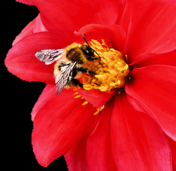
Ollerton, J., Stott, A., Allnut, E., Shove, S., Taylor, C. and Lamborn, E. (2007) Pollination niche overlap between a parasitic plant and its host. Oecologia. 151(3), pp. 473-485. 0029-8549.
- Information
Information
Abstract:
Niche theory predicts that species which share resources should evolve strategies to minimise competition for those resources, or the less competitive species would be extirpated. Some plant species are constrained to co-occur, for example parasitic plants and their hosts, and may overlap in their pollination niche if they flower at the same time and attract the same pollinators. Using field observations and experiments between 1996 and 2006, we tested a series of hypotheses regarding pollination niche overlap between a specialist parasitic plant Orobanche elatior (Orobanchaceae) and its host Centaurea scabiosa (Asteraceae). These species flower more or less at the same time, with some year-to-year variation. The host is pollinated by a diverse range of insects, which vary in their effectiveness, whilst the parasite is pollinated by a single species of bumblebee, Bombus pascuorum, which is also an effective pollinator of the host plant. The two species therefore have partially overlapping pollination niches. These niches are not finely subdivided by differential pollen placement, or by diurnal segregation of the niches. We therefore found no evidence of character displacement within the pollination niches of these species, possibly because pollinators are not a limiting resource for these plants. Direct observation of pollinator movements, coupled with experimental manipulations of host plant inflorescence density, showed that Bombus pascuorum only rarely moves between inflorescences of the host and the parasite and therefore the presence of one plant is unlikely to be facilitating pollination in the other. This is the first detailed examination of pollination niche overlap in a plant parasite system and we suggest avenues for future research in relation to pollination and other shared interactions between parasitic plants and their hosts.
Uncontrolled Keywords:
Bombus - Centaurea - Orobanche - Facilitation - Mutualism
Subjects:
Creators:
Ollerton, J., Stott, A., Allnut, E., Shove, S., Taylor, C. and Lamborn, E.
Publisher:
Springer Verlag
Faculties, Divisions and Institutes:
Date:
March 2007
Date Type:
Publication
Page Range:
pp. 473-485
Journal or Publication Title:
Oecologia
Volume:
151
Number:
3
Language:
English
ISSN:
0029-8549
Status:
Published / Disseminated
Refereed:
Yes
 |